
From our news archive
Compression testing at −30 °C
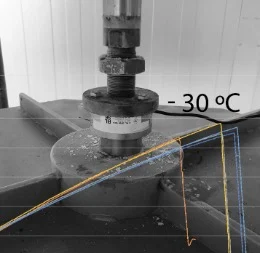
Despite a mild winter, it has been chilly at the NET test center. Recently, NET has carried out compression testing on plastic products at minus 30 degrees.
The low temperature leads to a reduction in movement of large parts of the molecular chain of a polymer (plastic). When a liquid polymer is cooled, it will turn into a rubber-like material and eventually become a solid. The temperature at which the polymer turns into a solid is called the glass transition point. This temperature is rarely at a completely defined limit, and will vary from plastic type to plastic type, and usually extends over a temperature spectrum. When tested at minus 30 degrees, certain types of plastic behave like a completely different product than they would at room temperature. After passing the glass transition point, the soft properties are greatly weakened, and the product is more easily crushed. Something it would never do at higher temperatures.
Testing at such low temperatures places completely different demands on the equipment, but it also makes it possible to see what a plastic product can be expected to withstand in a Nordic climate. At NET, we have the opportunity to carry out such testing in the temperature range - 30 ºC to + 60 ºC on finished products. In addition, we have EX safe climate rooms that make it possible to handle flammable substances in the same temperature range. The fact that we at NET choose to use climate rooms with such qualifications rather than climate chambers means that both equipment and larger packaging / products can be baled in the same climate. This gives us great flexibility.